
Top 12 Best 1 Mile Rangefinder That Hunters Swear By!
Trying to measure distant objects accurately can easily become frustrating when a rangefinder fails to deliver consistent results past its advertised limits. The best 1 mile rangefinder offers reliable readings at long distances without the blurriness or lag common in cheaper models.
A poor device might show fluctuating numbers or struggle in low-light conditions, making it difficult to trust the information it provides.
Durability matters most since these devices often face rough outdoor conditions; sturdy metal or high-quality plastic housing can prolong their lifespan. Optical clarity and lens quality directly impact how well the device performs at a mile, with better ones providing sharp images that don’t strain the eyes.
Power source efficiency and ease of use, like intuitive controls and clear displays, also distinguish reliable rangefinders in this category from those that quickly grow frustrating to operate.
Need a Quick Check?
| Image | Product | Price |
|---|---|---|
Our Top Picks 1  | Athlon Midas Rangefinder | Check Price |
Our Top Picks 2  | WOSPORTS Laser Rangefinder | Check Price |
Our Top Picks 3  | Athlon Midas G2 Rangefinder | Check Price |
Our Selected Top 12 1 Mile Rangefinder for Different Needs
This list features a variety of 1 mile rangefinders designed for different activities and preferences. Each review covers performance details, ideal user scenarios, strengths, and weaknesses to help readers choose the best option for their specific needs.
1. Athlon Optics Midas Laser Rangefinder
Built with waterproof materials to endure harsh weather, the Athlon Optics Midas Laser Rangefinder is ideal for golf enthusiasts who need a reliable and clear distance measurement device. Its standout feature is the fully multicoated optics that deliver exceptionally bright images even in low light conditions.
Setting it up is straightforward and it comes with a carrying case for protection. Daily use is simple thanks to the Scan Mode, which allows quick readings on various objects or tracking moving targets. The waterproof design ensures that unexpected rain or splashes won’t interrupt your game or activities.
Accuracy is dependable up to 1700 yards, covering a broad range of distances for golf and other outdoor uses. The optics deliver bright, clear views due to the effective light transmission technology.
Most find the build quality solid, with the lifetime warranty providing extra assurance. Some users have noted minor issues with button sensitivity during use.
Many appreciate how the rangefinder’s optics provide bright, clear images even in less-than-ideal lighting, making long distances easy to read. Common complaints focus on the buttons, which some find overly sensitive or difficult to manage during active use. The waterproof design effectively protects the device in wet conditions, adding to its durability.
Golfers looking for a dependable distance tool that stands up to weather will be satisfied with this model. Those needing a rangefinder specialized for other sports or broader outdoor activities might want to explore more versatile options.
Pros
- Waterproof for weather and accidental submersion
- Bright image with fully multicoated optics
- Quick readings with Scan Mode
- Long distance range up to 1700 yards
Cons
- Button sensitivity can be inconsistent
- Primarily designed for golf, limiting some outdoor uses
| Specification | Details |
|---|---|
| Effective Range Distance | 5-1700 yards |
| Brand Name | Athlon Optics |
| Waterproof | Yes |
| Sport Type | Golf |
| Included Components | Carrying Case |
| Warranty Description | Lifetime Warranty |
2. WOSPORTS Laser Rangefinder
Precision and speed stand out instantly with the WOSPORTS Laser Rangefinder. Designed for hunters and outdoor enthusiasts, it handles distances up to 2,300 yards, making it ideal for quick checks across open fields or tree lines.
Its greatest strength lies in delivering fast, accurate readings at long ranges.
Setting it up is straightforward thanks to the included user manual and rechargeable battery with USB charging. Daily use is convenient with three modes to switch between straight-line distance, angles, and speed measurements.
A 7X magnification helps in spotting targets clearly while scanning continuously. The compact size fits comfortably in hand or carry bag, making it easy to bring along on any hunting trip.
Performance is reliable, offering accuracy within 0.3 yard under 400 yards and staying precise up to 1,000 yards or more. The build feels solid with helpful extras like a hang string and lens cloth for maintenance. Most praise focuses on how quickly it delivers readings, though some mention the distance varies depending on environmental conditions.
Fast and accurate readings make the device reliable during hunts, but distance measurement can vary based on target type and environmental conditions. The battery recharge option and included accessories add convenience for daily use. It performs best when quickly checking distances across varied landscapes where speed matters.
Outdoor enthusiasts needing long-range accuracy and versatile measurement modes will appreciate this rangefinder. Those seeking a lighter, more compact device or uniform range consistency regardless of target type might explore alternate options better suited to their preferences.
Pros
- Fast readings in under 0.1 second
- Multiple measurement modes for varied terrain
- Rechargeable battery with USB charging
- Accurate at long distances up to 2,300 yards
Cons
- Performance varies with different target types
- Somewhat bulky compared to compact models
| Specification | Details |
|---|---|
| Maximum Range (Reflective Targets) | 2,300 yards |
| Magnification | 7X |
| Measurement Modes | Distance/Angle/Height/Speed/Continuous Scan |
| Accuracy | ±0.3 yard under 400 yards, ±1 yard under 1,000 yards |
| Included Components | Rangefinder, Carry Bag, USB Cable, User Manual, Hang String, Lens Cloth |
| Warranty | 2 Years |
3. Athlon Optics Midas G2 Laser Rangefinder
Choosing accuracy and durability over entry-level models suits serious hunters and shooters who need reliable readings up to one mile. Its rainproof optics and lifetime warranty make it stand out for harsh weather conditions and long-term use.
Setting up the rangefinder is straightforward with its simple, user-friendly design. The fully multi-coated glass improves visibility even in low light, while the OLED display with five illumination settings allows for clear readings in various lighting situations.
The rubber armor provides a secure grip, which is handy during extended outdoor sessions or rainy days.
The device performs well in delivering precise distance measurements within its one-mile range, which is essential for accurate shots or scouting. The rainproof and nitrogen-purged build keep the optics clear by shedding water, although it is not fully submersible. Most praise focuses on its excellent brightness and solid feel.
Common complaints mention the lack of submersion protection as a limit in extreme wet environments.
The strongest praise highlights the clear, bright optics and reliable performance under rainy conditions thanks to rainproof design. The most common complaint revolves around the unit not being submersible, which restricts use in extreme wet environments. The grip and display make it comfortable and easy to read for long periods in the field.
Hunters and shooters who face varied weather and need a dependable one-mile rangefinder will be satisfied. Those requiring a fully waterproof or smaller, more compact device might want to explore other options better suited for extreme water exposure or lighter carry.
Pros
- Rainproof optics effective in wet conditions
- Fully multi-coated glass for brighter images
- Rubber Armor provides firm, non-slip grip
- OLED display with adjustable illumination
Cons
- Not submersible, limits use in heavy water exposure
- Slightly bulky compared to compact rangefinders
| Specification | Details |
|---|---|
| Brand Name | Athlon Optics |
| Model Number | 502006 |
| Sport Type | Hunting, Shooting |
| Unit Count | 1 Count |
| Included Components | Athlon Optics 502006: Midas 1 Mile G2 Laser Rangefinder |
| Warranty Description | Lifetime Warranty |
4. MILESEEY G1 GPS Laser Rangefinder

Finding accurate distances on a golf course can be frustrating, especially with tiny, hard-to-read devices. Perfect for golfers who want clear, easy access to yardages, the Mileseey G1 GPS Laser Rangefinder stands out with its large 2.13” AMOLED touchscreen, making reading distances and course data straightforward without extra gear.
Setting it up is as simple as powering it on to access over 43,000 golf courses worldwide, no subscription needed. Navigating through the full-color touchscreen feels natural, you tap, swipe, and zoom just like on a smartphone, even under bright sunlight.
No need to carry your phone or download an app; everything you need fits right in the palm of your hand.
The rangefinder delivers fast, reliable measurements with 6X magnification and can lock onto flagpoles in 0.1 seconds, making shot decisions easier on the course. Its build quality supports smart slope compensation, adding useful distance adjustments.
While most find it straightforward and accurate, some mention the touchscreen may take a little time to get used to.
Many appreciate the easy-to-read large AMOLED display and the convenience of having course info without extra devices or subscriptions. A common note is that the touchscreen interface requires a brief adjustment period for smooth operation.
Golfers who want detailed course data and a fast, responsive laser with a modern interface will find this suitable. Those who dislike touchscreens or prefer simpler controls might look for a more traditional rangefinder instead.
Pros
- Large, bright touchscreen visible under sunlight
- Access to 43,000+ courses with free lifetime updates
- Quick flag lock with 0.1-second response
- No subscription or app needed
Cons
- Touchscreen can be tricky initially
- Some users may prefer simpler non-touch models
| Specification | Details |
|---|---|
| Screen Size | 2.13” AMOLED Touchscreen |
| Number of Courses | 43,000+ |
| Magnification | 6X |
| Max Range | 1300 Yards |
| Flag Pole Locking Speed | 0.1s |
| Warranty | 10 Year Manufacturer |
5. Vortex Sonora HD Laser Rangefinder
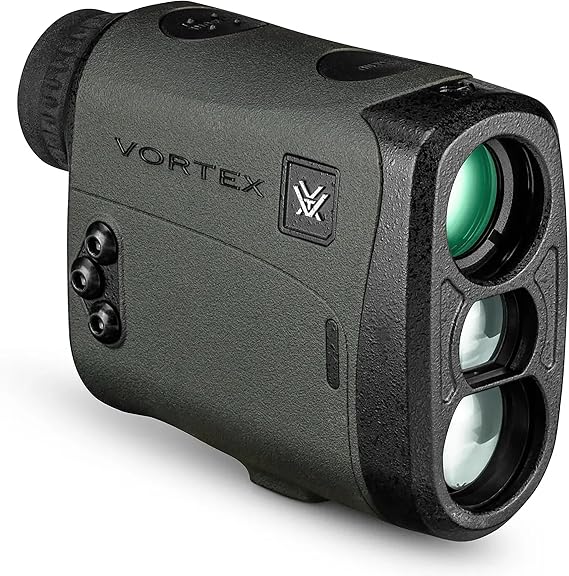
Capable of ranging up to 1,800 yards on reflective targets, the Vortex Sonora HD Laser Rangefinder is ideal for serious archery, hunting, and shooting. Its main strength lies in delivering precise distance measurements with 6x magnification, helping shooters get accurate data even on long-distance targets.
Setting it up is straightforward since it comes ready to use with a CR2 battery and a soft carry case. The fully multi-coated lenses and 21mm objective lens deliver clear visibility in different lighting conditions, making daily use simple and convenient. Angle compensation helps with more realistic distance readings on uneven terrain, which is crucial for bow and rifle shooters alike.
Accuracy is strong, with reliable readings up to 700 yards on game, and the HD optical system provides excellent resolution without color distortion. The build feels solid and durable, especially with the ultra-hard ArmorTek coating protecting the lenses from scratches and dirt. The main drawback noted is that the range to non-reflective animals maxes out around 700 yards, which might feel limiting to some users.
Users praise the exceptional clarity and precise distance measurements, especially appreciating the angle compensation feature for realistic range data. The most common frustration is the range limit when targeting animals, which caps at 700 yards compared to reflective targets.
People focused on hunting and shooting within these ranges will find it very reliable and well-built. Those needing longer effective ranges for game might want to look elsewhere or consider other devices designed for extended distances.
Pros
- Accurate distance readings up to 1,800 yards
- Angle-compensated ranging for better shots
- Clear HD optics with minimal color distortion
- Durable ArmorTek coating protects lenses
Cons
- Limited maximum range on game targets (700 yards)
- Bulkier than some compact rangefinders
| Specification | Details |
|---|---|
| Maximum Range on Reflective Targets | 1,800 yards |
| Maximum Range on Game | 700 yards |
| Magnification | 6x |
| Objective Lens Diameter | 21mm |
| Warranty | Unlimited, unconditional, lifetime warranty |
6. Leupold RX-1400I TBR/W Gen 2 Laser Rangefinder

Hunters and archers looking for reliable distance measurements up to a mile will appreciate this rangefinder. Its biggest advantage is the True Ballistic Range/Wind technology, which provides precise calculations even at steep angles and in windy conditions, helping make accurate long-distance shots more achievable.
Setting it up is straightforward, with quick mode selection between bow mode and rifle mode. The display uses bright red numbers that you can adjust for different light conditions, making it easy to read throughout the day.
You get useful hold points for wind and distance, simplifying shot adjustments in real-time during hunting or archery sessions.
Accuracy shines with ballistically calculated ranges out to 1,400 yards on reflective targets and 1,200 yards on trees, meeting the needs of most long-range outdoor activities. The build feels solid enough for regular field use.
While the laser rangefinder performs well in varied terrain, some users note it could be bulkier compared to compact models.
The rangefinder is praised most for its True Ballistic Range/Wind technology offering very accurate shot calculations in various conditions. The main complaint centers around its size, which feels larger than some prefer for everyday carry.
Hunters and archers looking for precision at longer distances will find it very useful. People prioritizing compactness or needing wind hold points for stronger or variable winds might want to explore other options.
Pros
- Battery life consistent with intense use
- Adjustable brightness for low light visibility
- Bow mode shows arrow obstructions clearly
- Lifetime warranty without hassle
Cons
- Somewhat bulky compared to smaller rangefinders
- Wind hold point limited to 10-mph at 90-degree angle
| Specification | Details |
|---|---|
| Model Number | 183727 |
| Ranging Distance | 1,400 yards on reflective objects, 1,200 yards on trees |
| Display | Selectable TOLED with bright red numbers and adjustable brightness |
| Sport Type | Hunting |
| Included Components | Range Finder |
| Warranty | Lifetime guarantee without proof of ownership |
7. Bushnell Golf A1 Laser Rangefinder

Compact and designed for golfers who want precise readings without bulk, the Bushnell Golf A1 Laser Rangefinder stands out with its pocket-size convenience and slope-adjusted distances trusted by PGA Tour pros. It excels by offering exact Play As distances that factor in elevation changes, ideal for serious golf enthusiasts focused on improving their game.
Setting up the device takes moments, with an easy toggle between slope mode and tournament-legal mode using the mode button. Its ultra-compact size fits comfortably in a pocket, helped by the included premium carry case. Using the 6x magnification makes spotting flags easier, while the USB-C charging keeps it ready without frequent battery changes.
The BITE Magnetic Skin helps secure it during rounds for quick access.
Accuracy extends well beyond basic yardage, covering 1 to 350 yards to flags and a total range up to 1,300 yards. The patented slope technology gives reliable uphill and downhill shot adjustments, making shot selection steadier.
Its build feels sturdy yet lightweight, perfect for carrying throughout a round. Most reviews commend its precision and compact form, though some users mention the challenge of lining up pins quickly under pressure.
The device delivers precise distances including elevation factors, making it trusted by PGA Tour players, yet using the pinseeker can sometimes slow quick target locking. The manual toggle for slope adjustment offers flexibility but requires remembering during tournament play.
Golfers who want reliable, compact laser rangefinding with slope readings will appreciate its accuracy and portability. Players seeking faster pin acquisition or who dislike managing mode switches might look for other options better suited for rapid play scenarios.
Pros
- Ultra-compact design fits pocket easily
- Accurate slope distance adjustments
- USB-C rechargeable for convenience
- 6x magnification for clear flag view
Cons
- Pin alignment can be tricky under pressure
- Auto slope mode needs manual toggle for tournaments
| Specification | Details |
|---|---|
| Magnification | 6x |
| Range to Flag | 1 – 350 yards |
| Total Range | 1,300 yards |
| Power Source | USB-C Rechargeable |
| Features | Pinseeker with JOLT, Slope On/Off |
| Warranty | 2 Year Manufacturer |
8. Golf Laser Rangefinder with Touchscreen

Jimillys Golf Laser Rangefinder with Touchscreen targets golfers needing accurate distance measurements up to a mile. Its standout feature is the 0.9-inch external touchscreen, offering quick access to distance, slope, and speed data without peering through the lens, making it ideal for players who value on-the-go information during their rounds.
Setup involves charging the built-in 1000mAh battery via USB-C, then attaching the rangefinder using the included mountaineering buckle or magnetic mount for hands-free use. Switching between yards and meters is straightforward on the touchscreen, and screen brightness adjustments ensure clear visibility in various light conditions. The hand strap adds convenience and security when carrying it around the course.
Accuracy stays within ±1 yard up to 1200 yards, aided by 7X magnification for clear targeting. The IP54 rating offers decent protection against moisture and dust, but some users note the touchscreen can be tricky to operate in bright sunlight. The metal and plastic casing feel solid, while the vibration feedback confirms pin lock, appreciated by many for confidence in measurements.
The external touchscreen effectively delivers instant distance and slope data, boosting convenience on the course. Vibration feedback when locking onto pins adds a reliable confirmation that many appreciate. However, the screen sometimes becomes hard to see under bright sunlight, leading to occasional frustration.
Golfers who prefer quick glanceable data and clear target confirmation will find this rangefinder fits well. Those frequently playing in very sunny conditions or wanting a more straightforward button interface might want to explore alternatives better suited for those needs.
Pros
- External touchscreen for quick data viewing
- Accurate within ±1 yard over long distances
- Rechargeable battery with USB-C charging
- Pin lock vibration confirms target alignment
Cons
- Touchscreen readability suffers in bright sunlight
- Some users find the interface less intuitive initially
| Specification | Details |
|---|---|
| Range | 5–1200 Yards |
| Magnification | 7X |
| Accuracy | ±1 Yard |
| Battery | 1000mAh Rechargeable via USB-C |
| Screen | 0.9-Inch External Touchscreen |
| Water Resistance | IP54 |
9. Callaway 300 Pro Golf Laser Rangefinder

Feeling precise in hand, this golf laser rangefinder suits players who want accurate distance readings up to a mile away. Its biggest strength lies in the slope measurement that adjusts distance for elevation changes, giving a reliable yardage advantage without second guessing.
Setting it up is straightforward with a quick start guide included. Day-to-day use shines through its 6x magnification, making it easy to spot targets on the course. Switching between slope on and off is simple with an external toggle, which keeps it legal for tournaments.
The pulse vibration confirms locked pins up to 300 yards clearly.
Accuracy holds strong with a range of 5-1000 yards and an error margin of only +/-1 yard. The build feels solid enough for regular golf rounds, supported by a carrying case and lens cloth for maintenance.
The best part is confident pin-locking at mid distances; some say the rangefinder can struggle with longer pin acquisitions occasionally.
Pin Acquisition Technology provides firm locking up to 300 yards with a vibration burst to confirm distances. Occasional difficulties occur with targets farther than that, leading to some missed readings. It excels at mid-range accuracy and slope corrections during typical golf rounds.
Anyone needing fast, clear slope-adjusted yardages will appreciate this laser. Those requiring pinpoint accuracy at very long distances might want to explore alternatives better equipped for extended pin acquisition.
Pros
- Accurate slope-adjusted distance calculation
- Quick pin-locking with pulse vibration feedback
- 6x magnification aids clear targeting
- External slope switch legal for tournaments
Cons
- Pin acquisition less reliable beyond 300 yards
- Some find vibration pulse subtle on fast shots
| Specification | Details |
|---|---|
| Range | 5-1000 yards |
| Magnification | 6x |
| Accuracy | +/- 1 yard |
| Pin Acquisition Distance | Up to 300 yards |
| Slope Feature | External Slope On/Off Switch |
| Included Components | Case, Lens Cloth, Quick Start Guide, Rangefinder |
10. REDTIGER Golf Laser Rangefinder

Great for golfers wanting precise distance measurements up to a mile, this rangefinder stands out for its accuracy and useful features. It suits players who need reliable slope switching and easy charging for consistent use in various weather conditions.
Setup involves attaching the magnetic mount or using the included belt clip to keep the device handy. Day-to-day use is simple with the transflective LCD display and 7x magnification for clear views. The slope switch toggles between regulation and slope reading modes, making it adaptable for both practice and competitions.
USB-C charging means no fuss with batteries.
Distance readings are accurate within 0.5 yards, covering up to 1200 yards, which covers nearly any golf course. The build feels sturdy and water resistant with an IP54 rating, so it handles light rain without issue. Many praise the flag pole lock with vibration for reliable targeting, while a common complaint notes some bulk compared to smaller models.
The strong suit of this device is its precision and reliable slope functionality, praised for giving quick, clear distance readouts. Vibration on the flag pole lock helps lock on targets well, though its strength varies according to some reports, which can affect feedback confidence during use.
Golfers who need dependable slope adjustments and extended range will appreciate this rangefinder. Those wanting a very compact, lightweight model might prefer looking elsewhere. Its extensive feature set makes it perfect for regular use, not just occasional play.
Pros
- High accuracy within 0.5 yards
- 1200 yards max range covers long distances
- Slope switch for competition compliance
- USB-C charging eliminates battery hassle
Cons
- Relatively bulky compared to compact models
- Flag pole lock vibration may be subtle for some
| Specification | Details |
|---|---|
| Maximum Measurement Range | 1200 yards |
| Accuracy | 0.5 yards |
| Magnification | 7x |
| Charging | USB-C rechargeable |
| Water Resistance | IP54 |
| Included Components | Magnetic belt clip, mountaineering buckle, hand rope, charging cable, lens cloth, soft case |
11. REVASRI Hunting Laser Rangefinder

Crafted with practical design in mind, the REVASRI Hunting Laser Rangefinder suits hunters, golfers, and archers looking for a device that remembers their preferred mode. Its biggest strength lies in the mode memory feature, saving you time by opening the last used mode instantly.
Setup is straightforward since it includes a battery and comes ready to use. Day-to-day use feels versatile with seven functional modes including ranging, scanning, speed measurement, and golf compensation.
Continuous scan mode lets you measure multiple targets easily by pressing once, and the device automatically updates angle, height, and distance details as you switch targets.
The rangefinder performs reliably across its measuring functions, giving precise data on distance and height. Built for multiple sports, it holds up well for regular outdoor use, though some may find the complexity of modes requires a bit of familiarization. The memory function is praised for convenience, while the most common drawback noted is the learning curve to master all its modes.
Users appreciate the memory function that opens the last used mode, making it convenient in the field. The rangefinder’s many modes provide flexibility, yet mastering them all takes effort and patience for smooth operation.
Anyone needing a versatile tool for hunting, archery, or golf will find it suitable, especially if quick mode recall matters. Those who prefer simple, straightforward devices might want a less feature-packed model.
Pros
- Remembers last mode used for quick startup
- Measures multiple targets continuously in scan mode
- Includes golf distance compensation mode
- Displays angle, height, horizontal and straight-line distances
Cons
- Complex modes require time to learn
- Some users may find menu navigation challenging
| Specification | Details |
|---|---|
| Sport Type | Hunting, Archery, Golf |
| Number of Functions | 7 (including speed measurement and height measurement) |
| Model Number | HK-600H-3 |
| Included Components | Battery |
| Warranty | 1 Year |
12. Maven CRF.1 Laser Rangefinder

Precision and clarity stand out immediately in this rangefinder, ideal for anyone who hunts or shoots at long distances. Its biggest strength lies in delivering quick, accurate yardage readings up to a mile, helping with exact targeting in the field.
Setting up is simple thanks to its compact design, which makes it comfortable to carry and easy to hold in one hand all day. The included microfiber pouch keeps it safe, while premium glass optics allow you to spot targets clearly even in low light. Operating it feels natural and straightforward, suited for rifle hunting, bowhunting, and target practice alike.
Accuracy is consistent and speedy, giving confidence in each measurement. Built with extra-low dispersion glass, it offers excellent clarity and color fidelity.
The lifetime warranty speaks to durability, although some point out that the weight could be lighter for longer trips. It handles its job well without unnecessary bulk.
The fastest and most precise distance reads stand out as the strongest praise for this rangefinder, while the most frequent complaint centers on its relatively heavy feel during long outings. Clarity and color accuracy consistently impress with the premium glass optics.
Hunters and shooters who prioritize quick, reliable yardage will appreciate this tool’s no-nonsense design. Those seeking a lighter or more feature-packed device might look elsewhere for their 1-mile rangefinding needs.
Pros
- Fast, accurate distance readings
- High-quality optics for excellent clarity
- Compact and easy to carry
- Includes protective microfiber pouch
Cons
- Could be lighter for extended use
- Limited features beyond basic rangefinding
| Specification | Details |
|---|---|
| Brand Name | Maven |
| Sport Type | Hunting |
| Unit Count | 1 Count |
| Included Components | rangefinder, microfiber pouch |
| Warranty Description | Lifetime Warranty |
| Item Highlight | Compact design for easy one-hand operation |
Best 1 Mile Rangefinders Side by Side Comparison
| Product | Sport Type | Max Range | Battery | Warranty |
|---|---|---|---|---|
| Athlon Midas Rangefinder | Golf | 1 mile (assumed) | – | Lifetime Warranty |
| WOSPORTS Laser Rangefinder | Hunting | – | Rechargeable | – |
| Athlon Midas G2 Rangefinder | Hunting, Shooting | 1 mile | – | – |
| MILESEEY G1 GPS Rangefinder | Golf | 1300 Yards | – | – |
| Vortex Sonora HD Rangefinder | Archery, Hunting, Shooting | 1800 Yards | – | Unconditional Warranty |
| Leupold RX-1400I Gen 2 | Hunting | – | – | – |
| Bushnell Golf A1 Rangefinder | Golf | – | USB‑C Rechargeable | – |
| Touchscreen Golf Rangefinder | Archery, Climbing, Golf, Shooting | – | USB-C Rechargeable | – |
| Callaway 300 Pro Rangefinder | Golf | – | – | – |
| REDTIGER Golf Rangefinder | Golf | – | Rechargeable | – |
| REVASRI Hunting Rangefinder | Hunting, Archery, Golf | – | – | 1 Year |
| Maven CRF.1 Rangefinder | Hunting | – | – | Lifetime Warranty |
- Sport TypeGolf
- Max Range1 mile (assumed)
- Battery–
- WarrantyLifetime Warranty
- Sport TypeHunting
- Max Range–
- BatteryRechargeable
- Warranty–
- Sport TypeHunting, Shooting
- Max Range1 mile
- Battery–
- Warranty–
- Sport TypeGolf
- Max Range1300 Yards
- Battery–
- Warranty–
- Sport TypeArchery, Hunting, Shooting
- Max Range1800 Yards
- Battery–
- WarrantyUnconditional Warranty
- Sport TypeHunting
- Max Range–
- Battery–
- Warranty–
- Sport TypeGolf
- Max Range–
- BatteryUSB‑C Rechargeable
- Warranty–
- Sport TypeArchery, Climbing, Golf, Shooting
- Max Range–
- BatteryUSB-C Rechargeable
- Warranty–
- Sport TypeGolf
- Max Range–
- Battery–
- Warranty–
- Sport TypeGolf
- Max Range–
- BatteryRechargeable
- Warranty–
- Sport TypeHunting, Archery, Golf
- Max Range–
- Battery–
- Warranty1 Year
- Sport TypeHunting
- Max Range–
- Battery–
- WarrantyLifetime Warranty
How to Choose the Best 1 Mile Rangefinder
Accuracy, range, and ease of use are the most important factors to consider when selecting a 1 mile rangefinder. Getting these right ensures reliable measurements and reduces frustration, saving money and trouble on returns or upgrades. Battery life and durability also contribute to long-term satisfaction.
Accuracy and Range
Counting on a device to consistently measure distances close to one mile can be tricky with some models, especially in different weather or lighting conditions. A reliable rangefinder typically offers a consistent measurement range from around 10 yards up to 1,760 yards (one mile) with minimal variation. Readings can become erratic if the device struggles with heat haze, fog, or varying light, which makes it harder to trust the numbers in the field.
Look for a model labeled with an accuracy of ±1 yard and confirm it performs well on reflective targets, which boosts dependability. Devices that struggle with shot-to-shot consistency cause wasted time and frustration when lining up shots or marking distances.
A good one keeps mistakes low by working equally well on close and far objects in daylight and moderate weather.
Optical Quality
Using a rangefinder with poor optics often leads to strained eyes and unclear target views, especially over long distances. A lens with good brightness and sharpness helps you identify specific targets at the full range, not just a blurry spot. Magnification around 6x is common and strikes a balance between zoom and field of view, keeping images steady without excessive shakiness.
Adjustable focus lets you zero in on targets of different distances easily, improving precision. Lenses coated with anti-reflective material reduce glare and improve contrast, which proves useful on bright days or in shaded areas.
A clear, bright sight matters a lot for practical use; struggling to see your target defeats the purpose regardless of the device’s range.
Build and Durability
Devices that fail under rough conditions quickly become more of a problem than a help. A durable outer shell made from rubberized or reinforced plastic can endure multiple drops or bumps without internal damage or cosmetic flaws. Many come with an Ingress Protection (IP) rating, like IP54 or higher, indicating resistance to dust and splashes of water, so a sudden rain won’t ruin your device.
Weight and size also affect how comfortable it is to carry and use for extended periods. Models weighing around 6-8 ounces balance sturdiness and portability, fitting easily in a pocket or pack without feeling bulky. A well-built device feels solid but not heavy, allowing you to stay focused on the task instead of adjusting your grip or worrying about damage.
Ease of Use and Features
Controls that are too complicated or fiddly slow you down when trying to get a quick reading. Rangefinders with one or two buttons that provide straightforward functionality save time and reduce mistakes.
Features like angle compensation are especially useful in hilly terrain by adjusting distance based on slope angle, which avoids overshooting.
Scan mode lets you continuously measure distances to moving or multiple objects. The screen should be easy to read in bright sunlight and dimmer light alike; a digital display with adjustable brightness levels usually works well. Clear icons and numbers without excessive clutter make it easier to interpret data quickly and confidently during use.
Battery Life and Power Source
Running out of power in the middle of a trip is frustrating and sometimes costly. Battery life around 8 to 10 hours of active use generally covers a full day in the field.
Many devices use CR2 or AA batteries, which are widely available and simple to replace. Rechargeable battery options offer convenience if you use the device often and can charge between outings.
Choosing a model with an easy battery compartment access helps swap power sources quickly. Some find rechargeable packs reduce the need to carry spares, while others prefer replaceable batteries for emergency bulk availability.
Either way, expect to check power levels before heading out to avoid surprises.
Optimizing Accuracy: How to Use Your 1 Mile Rangefinder Effectively
Accuracy depends largely on steady hands and clear sightlines. Before taking a reading, hold the rangefinder with both hands to minimize shaking.
Sharp focus on the target is essential; extra glare or fog can distort the laser’s path and give inconsistent readings.
Practical tips for effective use:
- Set your rangefinder’s sight to the specific environment, use a clear or reflective target for best results at long distances.
- Avoid measuring through glass or other transparent materials, as this can skew readings.
- Check the angle, measuring uphill or downhill requires adjusting for slope if your device has that feature.
- Use single measurements for quick checks and multiple ones when precision is necessary, then average out the result.
Taking these steps can improve the reliability of your 1 mile rangefinder, especially under different weather and lighting conditions.
Maintaining Your Rangefinder: Tips for Longevity and Peak Performance
Regular cleaning prevents dust and moisture buildup that interfere with lens clarity. Use a soft microfiber cloth to wipe lenses gently after each use, avoiding harsh chemicals that could damage coatings.
Maintenance tips for long-term use:
- Store the rangefinder in a dry, padded case when not in use to avoid impact damage.
- Check batteries frequently and replace them before they drain completely to avoid power issues mid-measurement.
- Inspect the casing and buttons for any cracks or debris, which might impair function.
- Test the seals on your waterproof or weather-resistant model occasionally by checking for moisture inside the lens or device.
Consistent upkeep keeps the rangefinder working reliably and extends its life, especially if used outdoors often.
Comparing Laser vs. GPS Rangefinders for Long-Distance Measurement
Laser rangefinders operate by sending a laser beam to the target and measuring the time it takes to reflect back, offering precise distance data immediately. This direct measurement is useful for clear, unobstructed lines of sight up to a mile.
GPS rangefinders calculate distance by using satellite positioning coordinates, which can be helpful in wider areas without direct targets, such as open terrain or golf courses. Their accuracy relies heavily on satellite signals and can be affected by obstacles or signal quality.
Considerations when choosing between them:
- Laser models excel in pinpointing exact objects downrange.
- GPS devices provide additional data like location tracking but can be less precise for single-point measurements.
- Battery life and responsiveness tend to favor laser rangefinders during repeated shots.
The choice depends on your typical environment and the type of distance measurement you need.
People Also Asked
How Do I Properly Care for a 1 Mile Rangefinder?
Keep the lens clean and store the rangefinder in a dry place to avoid moisture damage. Wiping the lens gently with a microfiber cloth after each use helps maintain clear readings.
Is a 1 Mile Rangefinder Safe to Use in All Conditions?
These devices generally work well in clear weather but can be less reliable in heavy rain, fog, or snow. Using a rain cover during bad weather can help protect the device and improve performance.
How Long Does a Typical 1 Mile Rangefinder Battery Last?
The battery usually lasts between 8 to 12 hours, depending on the model and how often you use it. Carrying spare batteries during long trips ensures you won’t run out of power unexpectedly.
Are 1 Mile Rangefinders Compatible with Other Hunting Gear?
Many rangefinders fit well with standard hunting optics and mounts, allowing easy integration into existing gear setups. Checking compatibility before buying can save hassle in mounting or adjusting gear later.
What Common Problems Should I Expect with a 1 Mile Rangefinder?
Common issues include inaccurate readings due to fog on the lens or weak batteries. Regularly calibrating the device and replacing batteries early can reduce these problems and keep measurements reliable.
Conclusion
Accuracy, ease of use, and clear visibility are the most important factors when choosing a 1 mile rangefinder. A device that gives consistent distance readings without complex adjustments is best. The display should be easy to read in different lighting conditions, and the build should be compact enough to carry comfortably.
Consider how often you’ll use the rangefinder and whether your budget matches the features offered. For occasional use, a simpler model might be sufficient, while frequent use may demand more durability and advanced optics.
Revisit the comparison table and product details above to find the one that fits your needs best.