
Top 12 Best Astronomy Spotting Scope You Can’t Miss!
Watching the night sky through a poorly made scope often leads to frustration. The view gets blurry, the lens fogs up easily, or the device feels too fragile to handle regular use.
A best astronomy spotting scope avoids these issues by offering clear visuals and a sturdy build that holds up under various conditions.
Good astronomy spotting scopes usually have objective lenses around 60 to 80mm to gather enough light for star viewing. They should offer magnification between 20x and 60x without causing too much image shake. Multi-coated glass is important for sharpness and contrast, while a waterproof, fog-proof design keeps the optics safe and clear.
Weight and size matter too, since a scope that’s too heavy or bulky makes setting up quick sky observations more difficult.
Need a Quick Check?
| Image | Product | Price |
|---|---|---|
Our Top Picks 1  | SVBONY SV28 Scope | Check Price |
Our Top Picks 2  | Unbranded 30-90×90 Scope | Check Price |
Our Top Picks 3  | Dual Screen 4K Scope | Check Price |
Our Selected Top 12 Astronomy Spotting Scope You Can Trust
This list features carefully chosen astronomy spotting scopes known for clear views and reliable performance. Each review explains how well the scope works, who it is best suited for, and highlights its main strengths and potential drawbacks to help you make an informed decision.
1. SVBONY SV28 Spotting Scope
Using the SVBONY SV28 Spotting Scope feels straightforward and reliable, especially for beginners wanting an easy-to-manage zoom range. It suits those who want to observe birds or scenery up close without fuss. The biggest strength is its adjustable 25-75x zoom paired with a bright 70mm lens that delivers clear images even in less ideal light.
Setting up the scope is simple and quick, whether attaching it to a tripod or using it by hand. The manual focus dial responds smoothly, letting you easily adjust as you switch between different targets. The extendable sunshade helps reduce glare on sunny days, while the non-slip finish keeps a steady grip even when conditions get damp.
Changing the magnification feels natural and precise, which helps in spotting details without losing sharpness.
Performance-wise, the optics do a solid job gathering available light to reveal fine details at high zooms, which is ideal for daytime use. The build quality is sturdy, and the waterproof design adds the security of being able to use it outdoors without worry.
Most praise highlights its bright images and user-friendly zoom, though some critiques mention the manual focus may require some patience to nail precise clarity on distant objects.
Bright and clear images during the day are a strong feature, making it great for spotting wildlife and scenic details. The manual focusing system requires patience and steady hands, sometimes making distant targets harder to lock onto sharply.
People new to spotting scopes or casual observers will appreciate the simple controls and solid optics here. Those needing fast focus or specialized low-light performance might want to explore other options better suited for those demands.
Pros
- Easy to adjust zoom from 25x to 75x
- 70mm lens offers good light gathering
- Non-slip, waterproof body ideal for outdoor use
- Built-in sunshade cuts down glare effectively
Cons
- Manual focus can be tricky to fine-tune
- Not optimized for very low light conditions
| Specification | Details |
|---|---|
| Zoom | 25-75x |
| Objective Lens Diameter | 70 millimeters |
| Focal Length | 380 millimeters |
| Focus Type | manual |
| Field of View | 64 feet |
| Mount | Equatorial Mount |
2. Unbranded 30-90×90 Spotting Scope
Great for anyone needing a rugged spotting scope with high magnification, the Visionking 30-90×90 balances power with durable construction. Its standout feature is the lightweight, shock-proof armor that protects it in rough outdoor conditions.
Setting it up is straightforward thanks to the included tripod, which offers stable observation from different angles. The smooth helical focus wheel makes fine adjustments easy, so you can quickly get a clear view.
The scope’s compact form helps when packing and carrying during outings.
Optical performance delivers sharp images across the zoom range from 30x to 90x, suitable for detailed astronomy or spotting distant wildlife. The rubber-coated frame feels solid and non-slip, supporting use in harsh weather.
The main drawback mentioned is the weight at over 3 kg, which can be noticeable over long periods.
The scope’s durable rubber coating and shock-proof design get frequent praise for handling tough weather and rough use. Commonly mentioned downside is its weight, making it less ideal for long handheld sessions.
Outdoor enthusiasts who prioritize sturdiness and high zoom will find it reliable. Those seeking a lighter or more premium-feeling body might explore other options.
Pros
- High magnification up to 90x
- Shock-proof rubber exterior
- Stable tripod for flexible angles
- Smooth helical focusing knob
Cons
- Weight over 3 kg can be tiring
- Plastic armor less premium feeling
| Specification | Details |
|---|---|
| Magnification | 30-90x |
| Objective Lens Diameter | 90 mm |
| Package Dimensions (L x W x H) | 22.2 x 8.9 x 6.9 inches |
| Package Weight | 3.13 kg |
| Item Dimensions (L x W x H) | 21.46 x 5.71 x 7.87 inches |
3. Dual Screen Spotting Scope with 4K Camera
Aluminum and multi-layer coated optics make this spotting scope well-built for astronomy and educational use. It suits anyone wanting clear views and high-detail images through both optical and digital magnification. Its dual screen setup stands out as a practical design for viewing and capturing images without disturbing night vision.
Setting it up involves mounting on a tripod and adjusting the manual focus manually for crisp images. Day-to-day use is straightforward thanks to the two screens: an external 2.8-inch screen that can rotate 90 degrees for flexible angles, and a large 10-inch built-in display.
The 18x digital zoom supplements the 350x optical magnification for detailed views of celestial objects. It’s also versatile for time-lapse photos and capturing selfies.
Performance is impressive for clear, bright images, helped by the F4.0 large aperture and excellent light transmittance from the coatings. Most praise highlights the image clarity and screen convenience, while a common complaint is the need for precise manual focus adjustment each time. The build feels sturdy for outdoor use but requires patience to get the best focus.
Image clarity and the two-screen design receive high marks, especially when observing in low light. Users note the manual focus can be tricky and slows down quickly getting sharp views. The scope is solid and well-suited to those comfortable adjusting focus manually for every observation session.
People passionate about capturing high-resolution space images and who want an interactive display will appreciate this scope. Hobbyists looking for quick autofocus or simpler handling might want to consider other options. It works best for those who enjoy hands-on control and detailed viewing setup.
Pros
- Stunning 4K 30MP photos and videos
- Dual screens for versatile viewing angles
- Large F4.0 aperture improves image clarity
Cons
- Manual focus requires careful adjustment
- External screen is relatively small
| Specification | Details |
|---|---|
| Mount | Tripod Mount |
| Focus Type | Manual Focus |
| Focal Length Description | 300mm |
| Field Of View | 1.5 degrees |
| Additional Features | Dual Screen Technology |
4. Leica APO-Televid 65 Angled Spotting Scope

Unmatched clarity through the 65mm objective lens makes this spotting scope ideal for anyone serious about detailed astronomy viewing. It suits users who want a durable, waterproof design combined with flexible magnification that adapts easily to different observation needs.
Setup is straightforward, especially with the manual focus and the included 25-50x zoom eyepiece, which lets you adjust magnification smoothly when observing the night sky. The compact magnesium housing is lightweight yet tough, and its waterproof sealing ensures there’s no worry about damp or fog during outdoor sessions.
Image quality impresses with excellent light transmission and color fidelity thanks to Leica’s HDC multi-coating and High Lux Pro lens system. The scope handles various lighting conditions well but requires careful handling to maintain the AquaDura coating.
Most praise focuses on the clarity and durability; a common complaint is the weight for some users.
The Leica delivers outstanding sharpness and true-to-life color, making details in the sky easier to pick out. Its waterproof, nitrogen-filled design protects against moisture, but some find the scope heavier than expected for field use.
Ideal for users valuing optical quality and durability on tough outdoor trips. Those seeking a lighter or simpler scope might want to explore other options better suited for frequent travel or quick setup.
Pros
- Exceptional image clarity with Leica HDC multi-coating
- Versatile 25-50x zoom eyepiece for varying distances
- Rugged magnesium housing is waterproof to 16.5′
- Manual dual focusing system offers precise control
Cons
- Relatively heavy compared to other spotting scopes
- AquaDura coating needs careful handling to avoid damage
| Specification | Details |
|---|---|
| Eye Piece Lens Description | Vario-Eyepiece 25x–50x WW ASPH. |
| Focus Type | Manual Focus |
| Focal Length Description | 65mm |
| Zoom Ratio | 25x–50x |
| Additional Features | Leica High Lux Pro (HLP) lens system, AquaDura coating, Dual focusing, Compact magnesium housing |
| Waterproof Depth | 16.5′ |
5. Unbranded 20-60×80 Spotting Scope
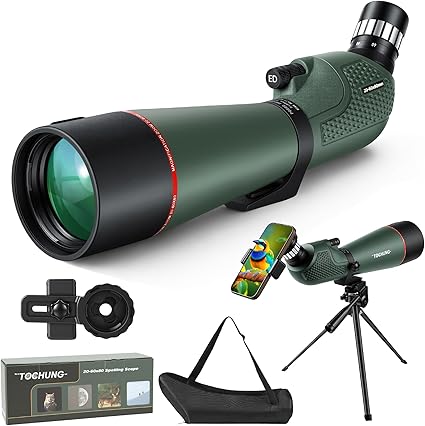
Offering 20x to 60x continuous zoom and an 80mm large-aperture lens, this spotting scope delivers clear and bright long-distance views. Perfect for birdwatchers, shooters, and outdoor enthusiasts looking for detailed observation without breaking the bank. Its main strength is handling distant subjects with sharp high-contrast imagery.
Setting up involves attaching the scope to a tripod mount and manually focusing, which gives precise control over clarity. The large fully multi-coated lens gathers light well, so views stay bright even at maximum zoom. A universal smartphone adapter lets you snap photos through the eyepiece, making it easy to capture what you see in the field.
Waterproof and fogproof features allow use in a variety of weather conditions without worry.
Performance is solid across different environments, providing high-definition detail from 20x all the way to 60x zoom. The build feels durable and dependable, suited to outdoor use.
Most praise goes to the bright and sharp images thanks to the optical coatings, while the common trade-off mentioned is the manual focus requiring some patience to get perfectly crisp views.
The scope delivers outstanding brightness and clarity thanks to its large aperture and coating system. Users appreciate the sharp detail when properly focused, though the manual focus can take a bit of practice to dial in perfectly. Daily use is enhanced by the tripod mount, making extended viewing comfortable.
Anyone aiming for detailed long-distance views in outdoor settings will find this scope a solid choice. Those needing quick autofocus or lighter equipment for hiking might want to consider alternatives better suited for rapid or highly mobile use.
Pros
- Bright views from fully multi-coated optics
- Good zoom range for detailed long-distance observation
- Waterproof and fogproof for all-weather use
- Smartphone adapter for easy photo capture
Cons
- Manual focus requires careful adjustment
- Heavier due to large 80mm objective lens
| Specification | Details |
|---|---|
| Zoom Ratio | 20x-60x |
| Mount | Tripod Mount |
| Focus Type | Manual Focus |
| Field Of View | 1000 yard |
| Additional Features | Fully Multi-Coated Optics, Waterproof & Fogproof, Universal Smartphone Adapter |
6. Digital Auto-Focus Refractor Telescope

Stargazing or wildlife spotting gets a major upgrade with a scope built for clarity and ease. Ideal for enthusiasts who want high-detail views combined with user-friendly tech, its strongest feature is the 350x zoom paired with a digital auto-focus system that grips sharp images even in tough light situations.
Setting up takes a few moments once you get the battery charged and inserted. The auto-focus means no fiddling with knobs, and the dual screens allow comfortable individual viewing or sharing the sights with others around. The anti-glare hood helps cut reflections, making use enjoyable whether you’re outdoors at dusk or deep night stargazing.
Wireless app and remote control add useful flexibility.
Bright stars, planetary details, and deep-sky objects come into sharp relief with a large 80mm aperture and starlight-grade optical sensor. The build feels sturdy, with convenient features like the flip-out external screen.
Most praise highlights the clear, crisp 4K views, while some note the need for specific, nonstandard batteries can be inconvenient.
Clear and vivid 4K views under low-light conditions earn praise, making detailed celestial and wildlife observations possible. Nonstandard battery requirements cause some frustration as replacements aren’t readily available.
People wanting straightforward electronic focusing and shared viewing will enjoy this scope’s capabilities. Those preferring long battery life without special batteries or simpler manual setups may look for alternatives better suited to those preferences.
Pros
- 350x magnification for detailed viewing
- Dual screens allow group and solo observation
- Auto-focus enables quick, sharp images
- Includes wireless app and remote control
Cons
- Requires nonstandard batteries, not always easy to find
- Battery life depends on rechargeable pack condition
| Specification | Details |
|---|---|
| Focus Type | Auto Focus |
| Finderscope | Reflex |
| Focal Length Description | 300mm |
| Additional Features | Auto Focus, Dual Screens, Wireless App Control, Remote Control, 4K Astrophotography, Starlight-grade optical sensor, Anti-glare hood, Rechargeable battery |
| Number of Batteries | Nonstandard Battery batteries required. |
7. Unbranded 20-60×80 Spotting Scope

Offering a powerful 20x to 60x zoom and an 80mm objective lens, this spotting scope works well for detailed long-range viewing. Suited for outdoor enthusiasts who want sharp images across activities like birdwatching, hiking, and stargazing, its biggest strength lies in its bright, clear optics thanks to the fully multi-coated lens and BAK4 prism.
Setting it up is straightforward with the altazimuth mount and manual focus. Adjusting the zoom feels smooth and precise, making it easy to lock onto distant subjects.
The included reflex finderscope assists quick targeting, while the smartphone adapter adds convenience for capturing images. Its water-resistant design adds durability for outdoor use during hikes or camping trips.
Image quality is crisp and bright, showing fine detail even at higher magnifications, which is the main appeal. Build quality is solid for the price, with a steady mount that holds position well.
Most appreciate the zoom flexibility, although some find manual focus a bit slow for fast-moving subjects. A few mention the weight can be noticeable on longer outings.
Sharpness and brightness come through as strong suits, with many appreciating the detailed views at high magnifications. On the downside, the manual focus requires patience, which can make tracking quick subjects more challenging.
Those looking for a versatile, bright spotting scope for varied outdoor activities will find this suitable. Users wanting faster autofocus or lighter models might look at other options better tailored for fast wildlife or active stargazing.
Pros
- Wide zoom range from 20x to 60x
- Bright, clear images with multi-coated lenses
- Compatible with smartphone adapters
- Water-resistant design for outdoor use
Cons
- Manual focus can be slow on moving objects
- Feels heavy during extended handheld use
| Specification | Details |
|---|---|
| Magnification | 20-60x |
| Objective Lens Diameter | 80mm |
| Field Of View | 82.9–48ft/1000 yards |
| Focus Type | Manual Focus |
| Mount | Altazimuth Mount |
| Prism Type | BAK4 Porro prism |
8. Unbranded 25-75×80 Spotting Scope

Ideal for anyone keen on birdwatching, hunting, or wildlife viewing, this spotting scope offers a powerful 25-75x zoom and a large 80mm objective lens for bright, detailed images. Its standout feature is crystal-clear optics combined with a wide field of view, making it a strong choice for an entry-level high-end scope.
Setup involves mounting the scope on a tripod, compatible with the included tripod mount, and manual focusing. The integrated phone holder lets you connect your smartphone for easy photo and video capture.
The reflex finderscope simplifies aiming at distant targets. Its classic optical system, with multi-coated BAK4 prisms, keeps day-to-day viewing sharp and colorful without needing extra power sources.
The scope delivers impressive clarity and color accuracy thanks to the large 23mm eyepiece and 80mm objective lens, handling various daylight conditions well. Build quality feels solid and reliable, matching its long sales record since 2019.
Most praise highlights the bright, clear images across the zoom range, while some users note the manual focus can be a bit fiddly at higher magnifications.
Bright and vivid viewing with sharp detail stands out as the strongest praise. The manual focusing mechanism, especially at the highest magnifications, is the most common complaint and requires some patience to use effectively.
Those wanting versatile wildlife spotting and smartphone compatibility will appreciate this scope. People needing quick autofocus or powered zoom might want to look at other options.
Pros
- Wide 98 feet field of view
- Multi-coated BAK4 prism optics
- Integrated phone holder included
- Compatible with tripod mounts
Cons
- Manual focus can be challenging at high zoom
- No powered adjustments available
| Specification | Details |
|---|---|
| Magnification | 25-75x |
| Objective Lens | 80mm |
| Eyepiece Lens | Bak4 Prism System |
| Focus Type | Manual Focus |
| Field Of View | 98 feet |
| Mount | Tripod Mount Compatible |
9. Celestron C90 Maksutov Spotting Scope

Compact and lightweight, the Celestron C90 Maksutov Spotting Scope stands out for its excellent optical design that folds the light path, making it much smaller than others with a similar focal length. Perfect for anyone who needs a portable option for bird watching, astronomy, or digiscoping, it offers bright, sharp views from a small package.
Setting it up takes just a moment, and the manual focus system feels precise and straightforward to use. Holding it steady on the included equatorial mount helps especially when looking at astronomical objects or distant targets. The multi-coated Plossl eyepiece offers clear images, and being able to attach your smartphone for photos makes it versatile for nature or shooting activities.
Its 8×21 finderscope aids quick target acquisition, and the whole setup is easy to carry around.
Optical performance delivers bright and sharp views, even with distant, small land targets or stars. The build quality reflects its portable design, with sturdy materials but a manual focus that might feel a bit slow under rapid target changes. Most users appreciate the compact size and image clarity.
Some wish for a quicker autofocus or a more advanced mounting system, but that’s a trade-off for its light weight and transportability.
Brightness and clarity stand out clearly among the strengths, making distant targets and night sky objects surprisingly detailed in a small form factor. The manual focus and equatorial mount get mixed reviews, as some find focusing slow and the mount less steady at maximum zoom levels.
People who treasure portability and want a versatile spotting scope with camera adaptability will find plenty to like here. Those needing fast autofocusing or more rugged mounting might want to explore other options instead.
Pros
- Compact and lightweight for easy portability
- Multi-coated optics provide bright, sharp views
- Camera adaptable for smartphone photography
- Equatorial mount aids steady aiming
Cons
- Manual focus can be slow for quick target changes
- Mount could be more stable for higher zooms
| Specification | Details |
|---|---|
| Eye Piece Lens Description | Plossl |
| Mount | Equatorial Mount |
| Focus Type | Manual Focus |
| Focal Length Description | 1250 millimeters |
| Finderscope | 8×21 Erect Image Finderscope |
10. Pentax PF-80ED-A 80mm Angled Spotting Scope

Pentax PF-80ED-A 80mm Angled Spotting Scope suits anyone wanting a flexible setup for detailed viewing, especially in astronomy. Its biggest strength lies in compatibility, accepting all 1.25 telescope eyepieces to fit different viewing needs comfortably.
Daily use involves setting up the altazimuth mount and manually focusing for clear images, which takes a bit of getting used to but feels precise. The angled 45° viewing makes observing the sky easier over long sessions.
It runs on battery power and has a reflex finderscope that helps point at objects quickly. Being fogproof and waterproof adds durability and confidence during outdoor use.
The scope’s 80mm lens and BAK4 Porro prism deliver sharp, bright images with a solid 3x zoom range, suitable for spotting distant celestial objects. Build quality is solid with UV protection adding to lens safety. Most praise highlights the optical clarity, while the need for a separate eyepiece sometimes causes inconvenience for quick setups.
The sharp optical quality receives praise as delivering clear views even at 3x zoom, but some find the absence of an included eyepiece inconvenient for spontaneous use. Manual focusing offers precision but requires patience during quick setup.
This spotting scope suits anyone who values lens compatibility and durability for extended observations. Those seeking a fully ready-to-go package without extra parts may want to consider options with included eyepieces or autofocus features.
Pros
- Accepts all 1.25″ telescope eyepieces
- Waterproof and fogproof for outdoor durability
- 45° angled viewing for comfortable sky observation
- Sharp optics with UV protection
Cons
- Eyepiece required separately for proper use
- Manual focus demands constant adjustment
| Specification | Details |
|---|---|
| Eye Piece Lens Description | BaK4 |
| Mount | Altazimuth Mount |
| Focus Type | Manual Focus |
| Power Source | Battery Powered |
| Field Of View | 1.14 degrees |
| Zoom Ratio | 3x |
11. Athlon Cronus G2 20-60×86 Spotting Scope

Using the Athlon Cronus G2 20-60×86 feels like having a powerful telescope in a compact, portable design. It suits those looking for detailed views of the night sky or distant terrestrial objects, with flexible magnification that adapts easily to different spots.
Its biggest strength is the combination of sharp optics and quick focus adjustments.
Setting it up is straightforward, thanks to the dual focus system that allows fast and precise tuning. The zoom range from 20x to 60x covers both wide and tight views without changing equipment.
Its protective coating means you spend less time worrying about smudges or scratches, making it perfect for daily outdoor use in varying conditions.
Clarity and contrast are impressive with the ED UHD glass and apochromatic lens system, reducing color fringing and enhancing details. The build feels solid, with an 8.6 cm objective lens that brings in plenty of light.
Most praise highlights the crispness and color accuracy, while some mention the weight can be a bit much for long handheld sessions.
Crisp images with very accurate color and contrast stand out as the biggest plus. The protective coating helps keep the lens clean during use. A common drawback is the weight, which might demand a solid tripod to get the best results, especially at high magnifications.
Anyone wanting detailed views and easy focusing will find this scope reliable. Those who need a lighter, more handheld device might want to consider alternatives since it is more comfortable on a steady base than held for long periods.
Pros
- Excellent clarity with ED UHD glass
- Quick, precise dual focus system
- Wide magnification range (20-60x)
- Durable XPL protective coating
Cons
- Heavier than some similar spotting scopes
- Higher magnifications require a stable mount
| Specification | Details |
|---|---|
| Objective Lens Diameter | 8.6 centimeters |
| Magnification Maximum | 60 x |
| Lowest Useful Magnification | 20 x |
| Zoom Ratio | 3:1 |
12. HAWKE Vantage 24-72×70 Spotting Scope

Great for birdwatching and nature observation, this spotting scope delivers sharp images with rich color and contrast. Ideal for anyone wanting a flexible zoom range and solid optics, it stands out for its detailed long-range viewing capabilities and bundled accessories.
Setup is straightforward with the adjustable mini tripod and integrated window mount that hold it steady during use. The individual focus type lets you dial in clarity quickly, and the manual winding mechanism ensures smooth operation without fuss.
Carrying it around is easy thanks to the hard storage case and soft cover that protect the optics between uses.
Optics are fully multi-coated with BK-7 Porro prisms, providing clear views across its 24 to 72x magnification range. The 70mm objective lens gathers plenty of light, making details pop at a distance.
Build quality leans practical with solid fittings and materials, with praise often going to its clear imaging. The most frequent downside involves the limited field of view at higher magnification, which can require extra patience to locate targets.
Sharp and colorful images stand out as the main benefit, helped by the fully multi-coated optics and BK-7 prisms. The frequent limitation is the reduced field of view when zooming high, meaning tracking moving subjects can be a bit tricky. Image quality is the highlight here.
Anyone looking for detailed long-range viewing with flexibility in magnification will appreciate this scope. Those needing a wider field of view or quicker automatic focus might want to consider other models better suited to fast action or wider scenes.
Pros
- Fully multi-coated optics for sharp, colorful images
- Wide zoom range for versatile viewing distances
- Includes tripod, hard case, and scope cover
- Comfortable to set up and adjust manually
Cons
- Narrow field of view at maximum zoom
- Manual focus requires steady handling
| Specification | Details |
|---|---|
| Magnification | 24-72x |
| Objective Lens Diameter | 70mm |
| Field of View | 84-42 ft at 1,000 yards |
| Focus Type | Individual Focus |
| Mount | Adjustable mini tripod with integrated window mount |
Best Astronomy Spotting Scopes Comparison Table
| Product | Magnification | Objective Lens Diameter | Mount Type | Additional Features |
|---|---|---|---|---|
| SVBONY SV28 Scope | 3:1 Zoom | 380 mm | Equatorial Mount | Waterproof, 45 degree |
| Unbranded 30-90×90 Scope | 30-90x | 90 mm | – | – |
| Dual Screen 4K Scope | – | 300 mm | Tripod Mount | Dual Screen Tech |
| Leica APO-Televid 65 Scope | 25x-50x | 65 mm | – | Vario-Eyepiece |
| Unbranded 20-60×80 Scope A | 20x-60x | 80 mm | Tripod Mount | Waterproof, Phone Adapter |
| Digital Auto-Focus Refractor | Auto Focus | 300 mm | – | Wireless Control, 4K Photo |
| Unbranded 20-60×80 Scope B | 60x | 20 mm | Altazimuth Mount | Phone Compatible |
| Unbranded 25-75×80 Scope | 25x-75x | 80 mm | Tripod Mount | Multi-coated |
| Celestron C90 Maksutov | 39x | 1250 mm | Equatorial Mount | 8×21 Finderscope |
| Pentax PF-80ED-A 80mm Scope | 3x | 80 mm | Altazimuth Mount | Battery Powered |
| Athlon Cronus G2 20-60×86 | 20-60x | 86 mm | – | – |
| HAWKE Vantage 24-72×70 Scope | 24x-72x | 70 mm | Adjustable Mini Tripod | Fully Multi-Coated |
- Magnification3:1 Zoom
- Objective Lens Diameter380 mm
- Mount TypeEquatorial Mount
- Additional FeaturesWaterproof, 45 degree
- Magnification30-90x
- Objective Lens Diameter90 mm
- Mount Type–
- Additional Features–
- Magnification–
- Objective Lens Diameter300 mm
- Mount TypeTripod Mount
- Additional FeaturesDual Screen Tech
- Magnification25x-50x
- Objective Lens Diameter65 mm
- Mount Type–
- Additional FeaturesVario-Eyepiece
- Magnification20x-60x
- Objective Lens Diameter80 mm
- Mount TypeTripod Mount
- Additional FeaturesWaterproof, Phone Adapter
- MagnificationAuto Focus
- Objective Lens Diameter300 mm
- Mount Type–
- Additional FeaturesWireless Control, 4K Photo
- Magnification60x
- Objective Lens Diameter20 mm
- Mount TypeAltazimuth Mount
- Additional FeaturesPhone Compatible
- Magnification25x-75x
- Objective Lens Diameter80 mm
- Mount TypeTripod Mount
- Additional FeaturesMulti-coated
- Magnification39x
- Objective Lens Diameter1250 mm
- Mount TypeEquatorial Mount
- Additional Features8×21 Finderscope
- Magnification3x
- Objective Lens Diameter80 mm
- Mount TypeAltazimuth Mount
- Additional FeaturesBattery Powered
- Magnification20-60x
- Objective Lens Diameter86 mm
- Mount Type–
- Additional Features–
- Magnification24x-72x
- Objective Lens Diameter70 mm
- Mount TypeAdjustable Mini Tripod
- Additional FeaturesFully Multi-Coated
How to Choose the Right Astronomy Spotting Scope
Choosing the right astronomy spotting scope involves considering factors like magnification, lens quality, and portability to ensure clear, sharp views of celestial objects. Getting these features right helps avoid frustration and costly upgrades, making stargazing more enjoyable and efficient.
Optical Quality
Seeing the craters on the moon or the bands on Jupiter only happens if the lens delivers good clarity and sharpness. Scopes with poor optics produce blurry or distorted images that make stargazing frustrating rather than enjoyable.
A magnification range around 20x to 60x works best for astronomy since it balances a zoom that’s powerful enough without making the image shake too much. Higher magnifications need more stability and can lose brightness.
Lenses with coatings are absolutely worth choosing because they cut down glare and help more light pass through, which is crucial during low light conditions typical of night sky viewing. Multi-coated lenses especially improve contrast, making faint stars and nebulae easier to see.
Without this, you’ll often miss details and struggle with washed out images.
Durability and Build
Using a scope on a cold, damp night means materials must endure moisture without fogging up or leaking. A weather-resistant or waterproof build is important so the scope doesn’t fail mid-session.
Aluminium or magnesium housing offers a good balance of strength and weight, standing up to bumps during transport.
Tripods with solid construction prevent annoying vibrations that blur the view at higher zoom levels. Cheap plastic mounts often wobble or slip, ruining steady observation. Look for about 1.2kg or heavier tripods with locking legs or adjustable angles for a solid setup that stays put throughout the night.
Portability and Size
Dragging a bulky scope uphill to your favorite dark sky spot quickly gets old. Scopes weighing under 3 kilograms and with compact dimensions fit into standard carrying cases and backpacks more easily. This makes getting to remote or tricky terrain less of a hassle.
Setup can take too long on some models, cutting into usable observation time. Designs that break down simply and put back together without tools save effort and frustration, meaning more moments actually watching the sky. Quick-release mounts or foldable legs help speed things up.
Field of View and Eye Relief
A wide field of view is valuable for locating planets or star clusters without constantly adjusting the scope. Narrow views make it feel like hunting for a needle in a haystack, especially for beginners. Around 60 to 70 degrees of field of view suits most practical celestial spotting needs.
Eye relief is another important factor, especially for people wearing glasses. At least 15mm of eye relief allows comfortable viewing without pressing your eye too close to the eyepiece. Smooth, adjustable focus knobs help fine-tune the image without jerky movements, which can be tiring during long sessions.
Additional Features and Accessories
Attaching a smartphone or camera to record or share impressive night sky moments requires compatibility with adapters. This adds a lot to enjoyment and can also serve as a learning aid. Protective lens caps keep elements like dust and moisture off the glass during transport, extending the product’s life.
Carrying cases that come with the scope or are available separately protect the investment and organize accessories. Some scopes include additional features like illuminated reticles for aiming in the dark or adjustable mounts that improve ease of positioning, both of which make setup and use more efficient.
Maximizing Celestial Views: Tips for Using Spotting Scopes in Astronomy
Spotting scopes offer a closer look at celestial objects through their powerful zoom capabilities, but positioning and settings are key to clear observation. Use a sturdy tripod to reduce vibrations which cause blurry images.
Start with lower magnification to locate objects, then adjust zoom gradually for detailed views. Atmospheric conditions can affect visibility; aim to observe on clear, calm nights to reduce distortion caused by air turbulence.
Several practical tips ensure the best viewing experience:
- Allow your eyes to adapt to darkness for at least 15-20 minutes before observing.
- Use a red flashlight to preserve night vision while adjusting your scope or star charts.
- Keep the scope’s lens caps off and clean, but avoid touching the lens surfaces directly.
- Choose high-quality eyepieces designed for low-light conditions to maximize brightness and detail.
Adjusting focus slowly and steadily helps maintain sharpness, especially when spotting smaller celestial bodies like craters or distant planets.
Essential Maintenance Practices to Keep Your Astronomy Spotting Scope in Top Shape
Routine care of an astronomy spotting scope extends its lifespan and improves performance during each use. Clean lenses gently using a microfiber cloth and specialized lens cleaning solution.
Avoid household cleaners as they can damage coatings. After each session, store the scope in a protective case to prevent dust and moisture buildup.
Key maintenance practices include:
- Checking and tightening any loose screws or joints to prevent wobbling.
- Inspecting the tripod for stability and lubricating moving parts if necessary.
- Keeping all caps on when the scope is not in use to shield optics from debris.
- Wiping external surfaces with a dry cloth to remove dirt and fingerprints.
Regularly monitoring the scope’s condition helps identify minor issues before they affect performance. Proper storage away from extreme temperatures or humidity also protects sensitive components.
Comparing Spotting Scopes and Telescopes: Choosing the Right Tool for Your Stargazing Needs
Spotting scopes and telescopes serve similar purposes but differ in design and function, influencing which suits various stargazing activities. Spotting scopes are compact and typically waterproof, making them versatile for daytime nature observing as well as astronomy. They provide moderate magnification and wider fields of view, which is helpful in scanning star clusters or the moon.
Telescopes generally offer higher magnification and larger apertures, designed specifically for deep-sky objects like galaxies or nebulae. However, they tend to be bulkier and require more setup and alignment.
Choosing the right instrument depends on:
- Your observation targets and level of detail sought.
- Portability needs and outdoor conditions.
- Budget and storage space.
Those wanting a straightforward, lighter option for casual stargazing often find spotting scopes easier to handle, while avid amateur astronomers may prefer the power of telescopes. Both offer rewarding views when matched with proper accessories and technique.
People Also Asked
How Do I Properly Care for My Astronomy Spotting Scope?
Clean the lenses gently with a microfiber cloth and avoid touching them with your fingers. Store the scope in its case to protect it from dust and moisture. Using lens caps when not in use can help keep the optics clear for longer.
What Size Spotting Scope Is Ideal for Stargazing at Night?
A scope with an aperture of about 60 to 80 mm is good for casual stargazing. This size provides a balance between portability and enough light gathering to see brighter stars and planets. Larger apertures offer brighter views but tend to be heavier.
Are There Any Safety Tips for Using a Spotting Scope Outdoors?
Avoid pointing the scope directly at the sun to prevent eye damage and lens damage. Set it up on stable ground to prevent tipping over. Carrying a tripod helps keep the image steady and reduces strain during long observations.
How Long Does a Typical Astronomy Spotting Scope Last with Regular Use?
A quality spotting scope can last several years with careful handling and proper maintenance. Regularly cleaning the lenses and storing it properly will prevent damage. Mechanical parts like focus knobs might wear after extensive use but can sometimes be serviced.
What Common Problems Should I Expect with a New Spotting Scope?
New scopes often have dust or smudges on the lenses out of the box, requiring a careful initial cleaning. Focusing mechanisms might feel stiff until used a few times. Sometimes the included tripod or mount might be flimsy and require an upgrade for better stability.
Conclusion
Choosing a good astronomy spotting scope mainly comes down to clear optics, solid build quality, and suitable magnification. These aspects affect how well you can see planets, stars, or the moon. Make sure the scope is easy to set up and stable on a tripod to keep your view steady during observation.
Consider where you’ll use the scope most often and how much you are willing to spend. A larger, heavier scope might be better for backyard use, while something compact could work better for travel. Check the comparison table and detailed picks above to find the right fit for your specific needs and budget.