
Top 12 Best Canon Rangefinder Camera You Can’t Miss!
Using a cheap or poorly chosen rangefinder camera can lead to missed shots due to slow focusing or inaccurate framing. The best canon rangefinder camera solves these common frustrations by offering precise manual controls and reliable focus mechanisms that keep up with quick, candid photography.
It avoids the lag and imprecision that often comes with budget alternatives, ensuring each shot is composed exactly as intended.
Key factors that distinguish a good rangefinder include the build quality, with durable metal bodies preferred for longevity and stability. Optical viewfinder clarity and alignment accuracy are also essential; tolerance within a fraction of a millimeter ensures sharp framing.
Finally, lens compatibility matters, cameras that accept a wide range of high-quality lenses, especially fast primes around f/2 or wider, provide the flexibility needed for different lighting and composition styles.
Need a Quick Check?
| Image | Product | Price |
|---|---|---|
Our Top Picks 1  | Canonet QL17 GIII | Check Price |
Our Top Picks 2  | Canon PowerShot Golf Rangefinder | Check Price |
Our Top Picks 3  | Canon PowerShot Golf Bundle | Check Price |
Our Selected Top 12 Canon Rangefinder Camera Picks for Every Need
This list features a selection of rangefinder cameras designed to meet various photography needs and skill levels. Each review covers how well the camera performs, who it is best suited for, and highlights its main strengths and weaknesses.
1. Canon Canonet QL17 GIII 35MM Rangefinder Camera
Canon Canonet QL17 GIII 35MM Rangefinder Camera shines as a reliable 35mm film camera, perfect for photography enthusiasts who appreciate a mix of classic manual control and shutter priority modes. Its standout feature is the sharp 40mm f/1.7 lens, which handles low light and everyday shots with ease.
Setting up the camera involves loading 35mm film and inserting a battery to power its exposure metering. The coincedence rangefinder focusing offers precise manual focus by aligning two images in the viewfinder. Adjusting shutter speeds manually or letting the camera handle priority gives flexibility depending on the shooting scenario.
The viewfinder magnification of 0.5-0.7x provides enough clarity to frame shots comfortably in bright or dim lighting conditions.
Performance is steady, with the mechanical shutter reliably working from 30 seconds to faster speeds. The build feels solid yet compact, typical for a 1972 Canon rangefinder. Users often praise the crispness of the 40mm f/1.7 lens but sometimes note the viewfinder can feel a bit dim compared to modern cameras.
The camera’s manual exposure control suits those who enjoy hands-on photography rather than point-and-shoot simplicity.
The camera is praised for its sharp lens and precise focusing, which give good control over image quality. Common criticism is about the battery dependency and the somewhat dim viewfinder, which can make focusing tricky in poor lighting.
Those who enjoy manual control and vintage 35mm shooting will find this camera rewarding. People looking for brighter viewfinders or fully mechanical operation without a battery might want to consider different models.
Pros
- Sharp 40mm f/1.7 lens for versatile shooting
- Supports shutter priority and manual modes
- Compact and sturdy build from 1972
- Precise manual focusing with rangefinder
Cons
- Requires battery for exposure meter operation
- Viewfinder may appear dim in low light
| Specification | Details |
|---|---|
| Film Format | 35mm |
| Lens | 40mm f/1.7 |
| Shutter Speed | Minimum 30 seconds |
| Viewfinder Magnification | 0.5-0.7x |
| Exposure Control | Manual |
| Focusing | Coincidence Rangefinder |
2. Canon PowerShot Golf Digital Laser Rangefinder
Handling it on the course feels straightforward and reliable, especially when you need quick, accurate distance measurements. Designed for golfers who value precision, the biggest strength lies in its combination of digital zoom and built-in slope correction, making it easier to aim for the pin regardless of terrain.
Starting with the measure button, activating image stabilization and laser rangefinding is instant and smooth. The 6x to 12x zoom helps spot the flag without straining your eyes. Rain doesn’t worry it much due to water resistance, so you can keep playing without interruption.
Switching off the laser to snap photos or videos lets you capture moments beyond the game, adding variety to daily use.
The distance readings come through fast and feel dependable, supporting better shot decisions. Its solid build resists light rain and fits comfortably in a golf bag or pocket. Strong points from reviews highlight the accuracy and zoom features, though some find the water-resistance level limited to light rain rather than heavy downpours.
The most praised feature remains its quick accuracy combined with slope correction, making it practical on uneven courses. On the downside, water resistance only withstands minor rain, so heavy weather could be an issue during play. The zoom and camera functions provide extra versatility beyond basic rangefinding.
Golfers who want reliable distance info and occasional photo use will find it a strong companion. Those needing full waterproofing or extreme zoom might want to look at other models better suited to harsher environments or longer-range viewing.
Pros
- Fast and accurate distance measurements
- Useful slope correction for inclination
- Digital zoom from 6x to 12x
- IPX4 water resistance for light rain
Cons
- Water resistance limited to light rain, not heavy wet conditions
- Some might prefer a higher zoom range beyond 12x
| Specification | Details |
|---|---|
| 6–12× Zoom Monocular | Yes |
| Image Stabilization | Built-in |
| Built‑in Camera (Photo & Video) | Included |
| Water Resistance | IPX4 Equivalent |
| Sport Type | Golf |
| Model Number | 6254C001 |
3. Canon PowerShot Golf Laser Rangefinder and Camera Bundle
Perfect for golfers wanting precision and convenience, this hybrid rangefinder and camera bundle shines with its accuracy on the course. It’s tailored for those who appreciate both smart club selection and capturing their game without lugging extra gear.
Setting it up is straightforward with the included 64GB Extreme Pro microSDXC memory card and USB-C cable for quick charging and data transfer. Daily use involves checking distances with laser precision and optical stabilization, making it easy to pick the right club.
The built-in camera lets you snap photos or record 1080p videos directly from the viewfinder, so there’s no need to carry a phone along.
Distance measurements are reliable with slope-adjusted yardage and pin-seeking accuracy, helping make smarter decisions on any golf course. The build feels solid and well-made, designed specifically for golfers. The clearest praise highlights its precision and the all-in-one convenience, while the main complaint points to occasional complexity using some advanced features.
The precise laser rangefinding combined with slope adjustments earns strong praise for helping golfers make smart club choices on varied courses. Users appreciate the convenience of the built-in camera letting them document their play without carrying extra devices. The complexity of some features creates frustration for those expecting simpler operation.
Golfers wanting accurate distance data and video capability in one tool will find this bundle very fitting. Players who prioritize compactness or simplicity in rangefinders may prefer a dedicated standalone device instead to avoid the added learning curve.
Pros
- Accurate slope-adjusted distance measurements
- 1080p video and built-in digital camera
- Includes large 64GB memory card
- Optical stabilization and zoom features
Cons
- Some advanced features can be tricky to use
- Bigger size compared to single-purpose rangefinders
| Specification | Details |
|---|---|
| Model Number | 6254C001_EDI_1 |
| Sport Type | Golf |
| Video | Full HD 1080p |
| Included Components | Rangefinder, 64GB Memory Card, USB-C Cable, Cleaning Kit |
| Manufacturer Part Number | 6254C001_EDI_1 |
4. Canon PowerShot Golf Digital Laser Rangefinder Bundle

Compact and designed with practical materials, the Canon PowerShot Golf Digital Laser Rangefinder Bundle suits golfers aiming for precision and quick measurements on the course. Its fastest readout speed and slope compensation stand out as its biggest strengths, making club selection more confident and accurate.
Setting up the rangefinder is straightforward, coming ready with a 32GB MicroSD card and protective case, perfect for on-the-go use. The automatic two axis image stabilization helps keep distant flags steady, while 12x digital magnification assists in clear viewing.
Quick continuous scanning makes tracking hazards and terrain changes easier during play.
Distance measurements range from 7 to 800 yards, with angle compensated slope correction improving accuracy. The device offers a rapid 0.8 second readout and eight second scan mode, showing reliability in the field.
Construction is solid, though some users find it can feel bulky when carried for extended periods.
Distance readings come quickly and accurately, helping with confident club choices. Reports indicate it sometimes feels heavier than expected, which can affect comfort over extended use.
Golfers wanting reliable slope compensation and clear views benefit here. Those who need a smaller, lighter device or prefer optical zoom might look elsewhere.
Pros
- Fast and accurate distance measurements
- Includes useful accessories like memory card and case
- Automatic two axis image stabilization
- Compact design suited for golf courses
Cons
- Can feel bulky during long carries
- Digital magnification less sharp than optical zoom
| Specification | Details |
|---|---|
| Distance Measurement Range | 7 to 800 yards |
| Readout Speed | 0.8 seconds |
| Magnification | Up to 12x digital |
| Included Components | Monoculars, 32GB MicroSD Card, Protective Case |
| Slope Compensation | Yes |
5. Canon EOS Rebel T7 DSLR Camera Kit

Sharp image quality with a 24.1 Megapixel APS-C sensor makes it great for hobbyists and beginners wanting to step up their photography. Its biggest strength is the improved Dual Pixel CMOS AF with eye detection, helping you capture quick, clear shots without fuss.
Setting it up is straightforward, thanks to the built-in Wi-Fi and NFC that quickly pairs with your devices. The 9-Point AF system and AI Servo AF work effectively for tracking moving subjects. The optical viewfinder offers about 95% coverage, maintaining a traditional shooting feel, and the creative filters add a fun way to experiment daily.
Performance is solid with sharp, detailed images and smooth focusing during video shoots, especially at 1080p resolution. The build is typical DSLR sturdy but not overly heavy. Positive notes often highlight the balance of automatic and manual controls.
The most common complaint relates to the viewfinder’s limited coverage, which can feel restrictive in framing.
Sharp image quality and smooth autofocus get repeated praise, making it a dependable option for clear pictures and video. The optical viewfinder’s roughly 95% coverage is the main drawback, causing some frustration in accurately framing shots.
Ideal for beginners and hobbyists seeking a simple DSLR with solid performance and wireless features. People wanting full viewfinder coverage or faster lenses might want to explore other options better suited to advanced needs.
Pros
- 24.1 Megapixel CMOS sensor captures sharp photos
- Dual Pixel CMOS AF with eye detection for smooth focusing
- Built-in Wi-Fi and NFC for easy sharing and control
- Creative filters and auto modes for fun photo experiments
Cons
- Optical viewfinder covers approx 95%, missing part of the frame
- Maximum aperture limited to 3.5 can restrict low-light creativity
| Specification | Details |
|---|---|
| Photo Sensor Resolution | 24.1 mp |
| Sensor Type | CMOS (APS-C) |
| Maximum Shutter Speed | 1/4000 seconds |
| Video Capture Resolution | FHD 1080p |
| AF System | 9-Point AF with Center Cross-Type Point |
| Connectivity | Built-in Wi-Fi and NFC |
6. Canon PowerShot V10 Compact Vlogging Camera

Choosing a compact camera that fits easily in your pocket yet handles vlogging like a pro is a real advantage. Ideal for creators always on the move, this vlogging camera stands out because of its low-light performance and a clever retractable front screen that makes framing yourself pretty straightforward.
Setting up is simple with automatic exposure control and a USB-C port for quick charging. The built-in stand folds both ways, offering flexible shooting angles without needing extra gear.
It’s lightweight and pairs easily with devices via Wi-Fi or Bluetooth, which means transferring videos and photos won’t slow you down during busy days.
Image quality benefits from a 1-inch 15.2-megapixel sensor that handles low light better than many compact cameras. Video captures come in crisp 4K resolution supported by true image stabilization to keep shots steady.
While the overall build is sturdy and ideal for mobile creators, the screen size limits detailed viewing and the camera isn’t water resistant, so extra care is needed outdoors.
The camera receives strong praise for its low-light capabilities and the front-facing screen which makes vlogging more approachable. Most common issues revolve around the small screen size, which doesn’t offer much detail when reviewing shots, and lack of water resistance that may restrict outdoor use.
People looking for a lightweight, easy-to-carry camera to record high-quality video and take good low-light photos will be pleased. Those needing a larger display for exact composition or waterproof features may want to look for alternatives better suited to those needs.
Pros
- Compact, pocket-sized design for portability
- Retractable front-facing screen for selfie framing
- Excellent low-light sensor performance
- Flexible built-in stand for versatile angles
Cons
- Screen is only 2 inches, limiting detailed previews
- No water resistance, careful use required outdoors
| Specification | Details |
|---|---|
| Effective Still Resolution | 15.2 mp |
| Image Stabilization | True |
| Video Capture Resolution | 4K |
| Exposure Control Type | Automatic |
| ISO Range | 100–6400 |
| Continuous Shooting Speed | 30 frames_per_second |
7. Canon EOS R8 Mirrorless Camera with RF 75-300mm Lens

Capturing sharp, colorful images on the go can be tricky, especially during travel or events. A compact mirrorless camera like this suits those needing quality and flexibility without bulk.
Its biggest strength lies in combining a full-frame sensor with a versatile telephoto lens, ideal for detailed shots from distance.
Setting up requires mounting the Canon RF 75-300mm lens, which gives a good zoom range for different scenarios. Switching modes is straightforward. Automatic exposure helps when lighting changes fast, and the lightweight 16-ounce frame reduces strain during long shoots.
The electronic viewfinder aids composing shots in bright conditions, while the included shoulder bag adds convenience for carrying everything around.
Image quality comes from the 24.2MP full-frame sensor that handles low light well and delivers vivid details. Video shoots can reach 4K resolution at 60fps, offering smooth motion and clarity.
The camera feels solid but lightweight in hand, making it easy to hold steady. A noted drawback is the lack of a built-in flash, limiting use in darker environments without extra gear.
Sharp image quality and strong low-light performance stand out as the camera’s best features. Many users appreciate the detailed photos and smooth 4K video. The absence of a built-in flash is the main complaint, requiring extra equipment for certain lighting conditions.
Anyone wanting a lightweight travel camera with telephoto reach will appreciate this setup. Lack of onboard flash or faster aperture may discourage photographers needing strong low-light or fill-light capabilities without additional gear.
Pros
- 24.2MP full-frame sensor captures vibrant colors
- Lightweight and compact body eases travel use
- 4K 60p video with oversampling for clarity
- Included telephoto zoom lens offers shooting flexibility
Cons
- No built-in flash for low-light support
- Lens aperture fixed at F4.0 limits low-light lens speed
| Specification | Details |
|---|---|
| Photo Sensor Resolution | 24.2 mp |
| Sensor Type | CMOS |
| Video Resolution | 2160p |
| Frame Rate | 60 FPS |
| Compatible Mountings | Canon RF |
| Item Weight | 16 ounces |
8. Canon EOS R50 Mirrorless Camera with 18-45mm and 75-300mm Lenses

Capturing up to 15 frames per second with an electronic shutter lets you freeze fast-moving scenes easily. Ideal for anyone wanting a versatile mirrorless camera with sharp images and reliable autofocus, it stands out for its 24.2 Megapixel APS-C sensor that delivers clear, detailed photos in various lighting conditions.
Setting it up takes just a few moments, especially with the included 18-45mm and 75-300mm lenses covering wide angles to telephoto shots. The touchscreen and automatic shooting modes make daily shooting straightforward. Advanced autofocus with 651 AF zones locks onto subjects quickly, making it a solid choice for both casual snaps and more demanding moments.
Image quality impresses with sharpness and rich detail thanks to the DIGIC X processor handling processing tasks swiftly. The build feels solid yet lightweight on your hands, suitable for extended use. Most praise focuses on the reliable autofocus and fast continuous shooting speeds.
The most common complaint is about the maximum aperture of f/4.5 limiting low-light performance on the telephoto lens.
The autofocus system stands out by reliably tracking people, animals, and vehicles with impressive speed. Users appreciate the sharp, detailed images the sensor and processor combination produces. Some find the f/4.5 aperture on the telephoto lens less suited for dim conditions, which might require higher ISO settings to compensate.
Those looking for a compact camera with quick focus and diverse zoom options will find this model satisfying. Photographers wanting full manual controls or wider apertures for low-light shooting might prefer other options. It suits well for vloggers, casual photographers, and anyone who values speed and clarity in a mirrorless setup.
Pros
- Fast continuous shooting at up to 15 fps
- Advanced autofocus covers entire frame
- Includes versatile 18-45mm and 75-300mm lenses
- Compact mirrorless design
Cons
- Maximum aperture of 4.5 limits low-light telephoto shots
- Limited manual exposure controls for advanced users
| Specification | Details |
|---|---|
| Photo Sensor Resolution | 24.2 mp |
| Photo Sensor Size | APS-C |
| High-Speed Continuous Shooting | Up to 15 fps (Electronic Shutter) |
| Maximum Aperture | 4.5 f_stop |
| Screen Size | 3 inches |
| Exposure Control | Program |
9. Canon EOS Rebel T7 DSLR Camera Kit (Renewed)

Photographers stepping into the Canon DSLR world will find a solid companion here. It suits those looking for a reliable entry-level camera with a generous kit of accessories.
The biggest strength lies in the complete bundle, which is ready to shoot right out of the box, covering a variety of photography styles.
Setting up the camera is straightforward thanks to the packed kit, including memory cards, lenses, and even editing software. Carrying it around feels comfortable at just 1.1 pounds. The 3-inch screen and optical viewfinder make framing shots easy in different lighting.
Built-in image stabilization and automatic modes help capture clear images without fuss.
Its 24.1-megapixel APS-C sensor delivers sharp images with good color detail. The camera handles aperture priority exposure well, taking decent photos with minimal effort.
A common complaint is the maximum aperture of f/3.5, which limits low-light shooting. The body feels durable, but some find it bulkier than mirrorless alternatives.
Sharp image quality and the complete accessory set impress users, making it ready for various shooting styles. The f/3.5 maximum aperture restricts low-light performance, which some found limiting in dim conditions.
Ideal for beginners who want a full DSLR experience without additional purchases. Those prioritizing compact size or superior low-light shots might look at other models or mirrorless options instead.
Pros
- Comes with extensive accessory bundle
- Lightweight at just 1.1 pounds
- 24.1 MP APS-C sensor provides detailed images
- Easy to use with automatic shooting modes
Cons
- Aperture limited to f/3.5 for low light
- DSLR form factor bulkier than mirrorless cameras
| Specification | Details |
|---|---|
| Photo Sensor Resolution | 24.1 mp |
| Sensor Type | APS-C |
| Maximum Aperture | 3.5 f_stop |
| Video Resolution | 1080p |
| Screen Size | 3 inches |
| Image Stabilization | Optical |
10. Canon EOS R7 Mirrorless Camera with RF 100-500mm Lens
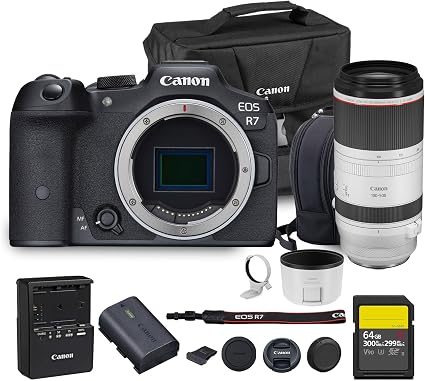
Offering a sharp 32.5MP APS-C sensor paired with a versatile 100-500mm lens, this Canon mirrorless camera suits photographers focused on wildlife, sports, and travel. Its ability to shoot 15 frames per second makes it stand out for capturing fast-moving subjects with precision.
Setting up involves pairing the camera body with the RF 100-500mm lens and inserting the included 64GB memory card. Day-to-day use flows smoothly thanks to its lightweight 2-pound mirrorless design and in-body image stabilization, which helps in maintaining steady shots.
Autofocus adjusts quickly with Dual Pixel AF II, making it easier to follow subjects on the move.
Its build feels solid and designed for extended use in the field, with a shoulder bag included to support mobility. Image quality is crisp, especially at 4K 60p video resolution and high shutter speeds down to 0.01 seconds.
Some users note the maximum aperture peaking at f/4.5 may limit low-light capability in certain situations.
The camera impresses with crisp detail and fast autofocus suitable for demanding subjects like wildlife. Its common limitation lies in the relatively narrow maximum aperture, which challenges shooting in dimmer environments. Users value smooth tracking and image stabilization for versatile shooting.
Photographers needing high-resolution and quick responsiveness will find this setup well-matched to their goals. Those prioritizing low-light performance or built-in flash should consider alternatives better equipped for those specific conditions.
Pros
- High-resolution 32.5MP APS-C sensor
- Fast 15fps for capturing action
- Includes versatile 100-500mm RF lens
- In-body image stabilization for steadiness
Cons
- Maximum aperture limited to f/4.5-7.1 range
- No built-in flash on the camera body
| Specification | Details |
|---|---|
| Sensor Type | CMOS APS-C 32.5MP |
| Lens Mount | Canon RF |
| Continuous Shooting Speed | 15 fps |
| Video Resolution | 4K UHD (2160p) at 60p |
| Image Stabilization | In-body Anti-Shake |
| Weight | 2 pounds |
11. Canon EOS R7 Mirrorless Camera Lens Bundle (Renewed)

Canon EOS R7 Mirrorless Camera Lens Bundle (Renewed) suits photographers and videographers looking for speed and detail in a compact APS-C body. It stands out for delivering fast shooting speeds up to 30 fps while maintaining high-resolution 32.5MP images.
Ideal for wildlife, sports, and multimedia creators seeking a nimble, powerful camera.
Setup involves attaching Canon RF lenses smoothly thanks to reliable mount compatibility. Daily use benefits from an intuitive 3-inch screen and an electronic viewfinder that helps frame shots clearly.
Sensor-shift image stabilization supports sharper images during handheld shooting. Controls include full manual and automatic exposure options, allowing quick adaptation to changing scenes.
Performance balances high-resolution stills with rapid burst shooting and solid autofocus using Dual Pixel CMOS AF II. Video capabilities include 4K at 60p, delivering smooth motion capture.
The camera feels well-built while remaining lightweight at just over 12 ounces. Common praises mention its speed and focus tracking accuracy; a noted drawback is the relatively modest maximum aperture of 7.1, limiting low-light lens options.
It receives strong praise for tracking fast-moving subjects accurately and producing sharp shots at high speeds. The most noted shortcoming is the smaller maximum aperture, which can challenge low-light shooting and creative depth of field control.
Photographers who prioritize a lightweight, fast, and sharp APS-C mirrorless camera will find this a solid choice. Those needing brighter aperture lenses or greater flexibility in low light might look toward cameras with different lens ecosystems or full-frame sensors.
Pros
- High-speed 30 fps continuous shooting
- Accurate Dual Pixel CMOS AF II autofocus
- Compact and lightweight at 12.48 ounces
- Supports 4K video up to 60p
Cons
- Maximum aperture only 7.1, less ideal in low light
- Limited lens options compared to full-frame systems
| Specification | Details |
|---|---|
| Sensor Type | aps-c |
| Photo Sensor Resolution | 32.5 mp |
| Maximum Aperture | 7.1 f_stop |
| Image Stabilization | Sensor-shift |
| Video Resolution | 1080p, 4K UHD 2160p |
| Viewfinder | Electronic |
12. Canon EOS R7 Mirrorless Camera with RF 100-500mm Lens Bundle

Using a mirrorless camera with the reach of a 100-500mm lens feels powerful for wildlife and sports photography. Suited for enthusiasts and professionals who value detail in fast-moving subjects, its biggest strength is the 32.5MP APS-C sensor combined with an impressive telephoto zoom.
Setting up involves attaching the RF 100-500mm lens and adjusting settings through an electronic viewfinder. Dual Pixel AF II makes getting sharp focus quick and reliable.
The in-body image stabilization reduces blur in handheld shots, and 4K 60p video lets you capture smooth, detailed footage. Carrying the shoulder bag included keeps the gear organized on the go.
Performance matches the rugged feel, with steady high-speed continuous shooting perfect for action. The build feels solid yet not too heavy at 2 pounds, suitable for extended handheld use.
High praise centers on sharp image quality and effective stabilization, though some find the maximum aperture of f/4.5 at the telephoto end a bit limiting in low light.
Sharp image quality and dependable autofocus receive consistent praise among reviewers. Some express concern over the aperture limitation affecting low-light shooting, especially at maximum zoom.
Photographers focusing on wildlife or sports who need powerful zoom and fast shooting will appreciate this camera. Those requiring wider apertures for dim environments might consider alternative options.
Pros
- High-resolution 32.5MP APS-C sensor
- In-body image stabilization helps reduce blur
- Dual Pixel AF II delivers fast, accurate focus
- Includes versatile 100-500mm telephoto lens
Cons
- Maximum aperture narrows to f/4.5 at telephoto end
- Compact design adds weight with full kit
| Specification | Details |
|---|---|
| Photo Sensor Resolution | 32.5 mp |
| Sensor Type | CMOS |
| Maximum Aperture | 4.5 f_stop |
| Video Resolution | 2160p, 1080p |
| Image Stabilization | Sensor-shift |
| Compatible Mountings | Canon EF, Canon EF-S, Canon RF |
Best Canon Rangefinder Camera Comparison Table
| Product | Film Format | Shutter Type | Exposure Control | Viewfinder Magnification |
|---|---|---|---|---|
| Canonet QL17 GIII | 35mm | Mechanical | Manual | 0.5-0.7x |
| Canon PowerShot Golf Rangefinder | – | – | – | – |
| Canon PowerShot Golf Bundle | – | – | – | – |
| Canon PowerShot Golf Laser Bundle | – | – | – | – |
| Canon EOS Rebel T7 Kit | APS-C | – | Automatic | – |
| Canon PowerShot V10 Vlog Cam | – | – | Automatic | – |
| Canon EOS R8 75-300mm | Full Frame | – | Automatic | – |
| Canon EOS R50 Dual Lens | APS-C | – | Automatic | – |
| Canon EOS Rebel T7 Renewed | APS-C | – | Optical | – |
| Canon EOS R7 100-500mm | CMOS | – | Automatic | – |
| Canon EOS R7 Lens Bundle | APS-C | – | Manual & Automatic | – |
| Canon EOS R7 100-500mm Bundle | CMOS | – | Automatic | – |
- Film Format35mm
- Shutter TypeMechanical
- Exposure ControlManual
- Viewfinder Magnification0.5-0.7x
- Film Format–
- Shutter Type–
- Exposure Control–
- Viewfinder Magnification–
- Film Format–
- Shutter Type–
- Exposure Control–
- Viewfinder Magnification–
- Film Format–
- Shutter Type–
- Exposure Control–
- Viewfinder Magnification–
- Film FormatAPS-C
- Shutter Type–
- Exposure ControlAutomatic
- Viewfinder Magnification–
- Film Format–
- Shutter Type–
- Exposure ControlAutomatic
- Viewfinder Magnification–
- Film FormatFull Frame
- Shutter Type–
- Exposure ControlAutomatic
- Viewfinder Magnification–
- Film FormatAPS-C
- Shutter Type–
- Exposure ControlAutomatic
- Viewfinder Magnification–
- Film FormatAPS-C
- Shutter Type–
- Exposure ControlOptical
- Viewfinder Magnification–
- Film FormatCMOS
- Shutter Type–
- Exposure ControlAutomatic
- Viewfinder Magnification–
- Film FormatAPS-C
- Shutter Type–
- Exposure ControlManual & Automatic
- Viewfinder Magnification–
- Film FormatCMOS
- Shutter Type–
- Exposure ControlAutomatic
- Viewfinder Magnification–
How to Choose the Right Canon Rangefinder Camera
Choosing the right rangefinder camera involves considering factors like build quality, lens compatibility, and ease of use, as these affect both performance and long-term satisfaction. Paying attention to these details helps avoid costly mistakes and ensures a smoother photography experience.
Image Quality and Sensor
Some cameras have sensors that handle low light much better than others, and that difference becomes clear in dim scenes like indoor settings or dusk shots. Sensor size is critical; larger sensors typically capture more detail and produce less noise, while resolution (megapixels) influences how sharp images appear when enlarged.
A small sensor with a high megapixel count can struggle with noise, so balancing size and resolution matters. Color reproduction and dynamic range affect how natural and detailed images look. Models with a broader dynamic range retain more detail in shadows and highlights, which matters for contrasty scenes.
Lens quality also significantly impacts sharpness and clarity since even the best sensor won’t fix a blurry lens. Look for cameras compatible with well-reviewed lenses that have good optical construction, often metal barrels and quality glass, to get the best out of your shots.
Build and Ergonomics
Metal bodies might last longer, but can add noticeable weight that wears you down on long shoots. Plastic or composite materials reduce weight but may not withstand heavy use.
Grip design really influences comfort. Some cameras have ridged or rubberized grips that feel secure in the hand; others are smooth and easier to drop when your hands sweat or get tired. Control layout is another factor that affects speed and ease of use.
Buttons and dials clustered near the thumb or index finger let you adjust settings without shifting your grip. For carrying around, size and weight can be a dealbreaker.
Compact bodies fit into small bags but might sacrifice some controls, while heavier ones provide more stability when shooting handheld.
Focusing System
Manual focusing through a rangefinder requires patience and steady hands. The actual patch in the viewfinder where images align can be tricky to see clearly, especially in low light.
This visibility affects how accurately you can focus and avoid blurry shots. The size and contrast of the focusing patch vary between models, with some offering brighter or higher-contrast patches that make aligning easier. Responsiveness of the focusing mechanism matters for quick subjects or street scenes.
Some rangefinders have smoother, faster focus rings or mechanisms that don’t lag or stick, which helps nail focus quickly. Slower or less precise focusing makes missed shots common, especially when chasing moving targets or shooting fast events.
Battery Life and Power Management
Typical battery life for these cameras usually ranges from a few hundred to around a thousand shots per charge, depending on the model and usage. Some run on standard replaceable batteries, which you can swap out on the go, while others rely on rechargeable batteries requiring a charger and downtime. Power-saving features like automatic shutoff after inactivity can extend time between charges but don’t expect days of continuous use.
Battery level indicators on the camera help avoid surprises mid-shoot by showing remaining power clearly. Models without clear indicators force you to guess and risk running out unexpectedly.
Viewfinder and Display
The viewfinder is your window to perfect framing, so clarity and brightness make a significant difference. High-quality rangefinder viewfinders offer sharp, bright views even on overcast days or in shaded areas, reducing eye strain during extended use.
Magnification affects what you see and how easy it is to shoot at different focal lengths; typical rangefinder magnifications range from about 0.55x to 0.7x, balancing field of view and focusing precision. Frame lines inside the viewfinder assist with accurate composition, showing the boundaries of different lenses. Additional displays or indicators, such as exposure or focus confirmation, vary by model and can make shooting faster by providing instant feedback without glancing away from the finder.
Proper Maintenance and Care for Your Canon Rangefinder Camera
Rangefinder cameras like the Canon models require regular maintenance to keep them functioning smoothly. Clean the lens and viewfinder with a microfiber cloth to prevent scratches and maintain clear image quality.
Dust and debris can accumulate inside the rangefinder mechanism, so it’s important to have the camera professionally serviced periodically. Avoid exposing the camera to extreme humidity or temperature changes, which can cause fungus growth or damage to delicate parts.
Basic maintenance tips include:
- Store the camera in a dry place with silica gel packs to minimize moisture.
- Remove the battery if the camera won’t be used for extended periods to prevent corrosion.
- Use a blower brush to clear dust without touching sensitive glass surfaces.
Taking these practical steps extends the life of Canon rangefinder cameras and keeps them ready for precise framing and focusing.
Common Mistakes to Avoid When Using a Canon Rangefinder
One common mistake with Canon rangefinders is not accurately aligning the rangefinder patch for focusing, particularly at close distances. This results in slightly blurred images because the focusing mechanism relies on matching two images precisely.
Avoid rushing composition through the viewfinder without checking focus clarity.
Another frequent error comes from neglecting to set ISO or film speed correctly, which can affect exposure quality. Since many Canon rangefinders are manual or partially manual, exposure settings need attention to avoid under- or overexposed shots.
Using incompatible lenses or adapters without confirming mount type can damage the camera or cause focus issues. Also, mishandling the camera when loading film may lead to frame spacing errors or light leaks.
Comparing Canon Rangefinders with Other Rangefinder Brands
Canon rangefinder cameras stand out for their solid build and smooth focusing compared to some other brands. Their viewfinder typically shows bright, clear framelines, which aid in precise composition. In contrast, brands like Leica offer more compact bodies, but often at higher prices and with slightly different focusing systems.
Some rangefinder models from other manufacturers provide electronic features absent in Canon’s manual designs, which can be a pro or con depending on user preference for classic operation versus convenience.
- Canon cameras generally offer excellent mechanical durability with straightforward controls.
- Some competitors focus more on digital integration over traditional rangefinder mechanics.
- Lens availability and compatibility vary across brands and influence photographic choices.
Choosing between Canon and other rangefinder brands depends on what features and handling qualities matter most to the photographer.
People Also Asked
How Do I Properly Clean and Maintain My Rangefinder Camera?
Clean the camera body and lenses with a soft, lint-free cloth to avoid scratches and dust accumulation. Use a blower brush for the viewfinder and rangefinder window, but avoid touching internal components. Regular maintenance includes occasional checking of light seals and mirror foam for deterioration that could cause light leaks.
What Size Lenses Are Compatible with This Rangefinder Camera?
Most Canon rangefinder cameras accept M39 screw mount lenses or Leica thread mount, commonly called LTM. Some models also support Canon’s proprietary FL or FD mounts with adapters. When buying lenses, verify the mount type to ensure compatibility without forcing parts.
Is It Safe to Use Vintage Film in This Rangefinder Camera?
Vintage film can work well with rangefinder cameras if stored properly and not expired long ago. Check for any signs of moisture or damage on film rolls before use. Using fresh, correctly loaded film helps avoid jams and inconsistent exposures common with older films.
How Long Does the Shutter Mechanism Typically Last in These Cameras?
The shutter mechanism generally lasts tens of thousands of actuations but varies depending on the model and care. Regular exercise of the shutter and proper lubrication by a technician extend its lifespan. Avoid heavy use without service, especially in very old cameras.
What Are Common Problems Encountered with Rangefinder Cameras and Solutions?
Common issues include light leaks from worn seals, shutter timing problems, and rangefinder misalignment. Replacing foam seals, having the shutter adjusted by a professional, and calibrating the focus mechanism can resolve these problems. Keeping the camera dry prevents many issues.
Conclusion
Choosing the best Canon rangefinder camera comes down to figuring out how you plan to use it, the lens compatibility you need, and how much manual control you want. Pay attention to size and weight too, since rangefinders are often carried for long periods. Those factors directly affect your shooting experience and the results you can achieve.
Think about your budget and storage space before making a final choice, especially if the camera will be a regular part of your gear. Check the comparison table and the detailed picks above to see which options fit your needs and price. That will help you find a camera that suits your style and setup without surprises.